
Cedar Falls Epoxy Flooring has spent more than 20 years installing industrial epoxy flooring in Cedar Falls, IA, serving surrounding cities including Waterloo, Evansdale, Waverly, Independence and Oelwein. Industrial floors carry forklifts, pallet jacks, racking and dropped parts, and they see oil, coolant, hydraulic fluid and cleaning chemicals every shift, so the system has to be chosen for the abuse rather than the look.
The work also has to fit around production. We phase plant floors by area, schedule grinding and coating for nights, weekends and shutdowns, and give your planners a written return-to-service time for each section before we start.
What does not bend is the preparation. Every slab is ground or shot blasted to a named surface profile, contaminated concrete is dealt with before any coating goes down, and a moisture test is written into the scope before the price is final.
Industrial Floors in Cedar Falls
Manufacturing, Foundry and Machining Floors
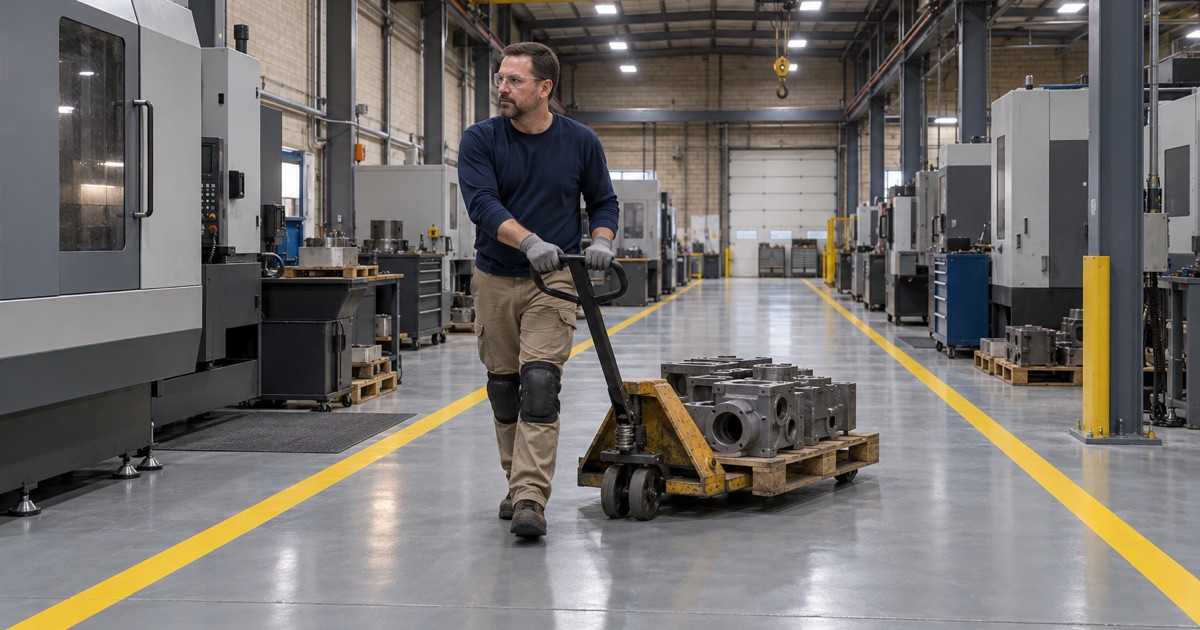
Cedar Falls has a long manufacturing base, including foundry and pump work in the older industrial areas and newer plants in the city’s industrial parks. Those floors see cutting fluids, quench oils, hydraulic leaks and heavy parts, and bare or thinly painted concrete soaks up every drip.
We use thick, chemical-resistant systems on these floors and plan joint and edge details carefully. Where hot work or heavy impact is routine, we recommend urethane cement or an epoxy mortar rather than a thin coating.
Engineering Labs and Test Cells
The city is home to engineering test facilities such as Deere’s Product Engineering Center, which announced a tractor-testing laboratory expansion of nearly 62,000 square feet in 2014, and Viking Pump’s lab, where pumps are tested with large tanks of oil. Floors in rooms like these need to stay clean, level and resistant to the fluids being tested.
We do not claim work for any particular facility. What we bring to lab floors is careful phasing around equipment, slab testing and systems chosen for the specific spills and loads each room sees.
Warehouses and Distribution Floors
Warehouse floors take constant wheel traffic, racking loads and pallet drag. A coated or densified floor reduces concrete dusting, makes floors easier to sweep and brightens aisles with a lighter color. We add safety lanes, pedestrian walkways and hazard markings as part of the coating system, so they wear with the floor rather than peeling as separate paint.
Systems for Heavy Industrial Use
High-Build Epoxy and Epoxy Mortar
For general manufacturing and warehouse floors, a high-build 100 percent solids epoxy applied at a specified thickness gives strong chemical and abrasion resistance. Where impact is heavy, a troweled epoxy mortar of resin and graded aggregate builds a much thicker, tougher surface. The quote names the system, the coat count and the finished thickness, so your maintenance team can check what was installed.
Urethane Cement for Heat and Thermal Shock
Urethane cement handles hot water, steam cleaning, thermal shock and many aggressive chemicals better than standard epoxy. It is common in food plants, washdown areas and process rooms where floors are cleaned hot or exposed to temperature swings. It can also be installed on slabs with higher moisture readings than many epoxies tolerate, though we still test first and follow the manufacturer’s limits.
Working Around Production
Phasing, Shifts and Shutdowns
We map the floor with your production and maintenance teams, then break it into phases that keep critical lines running. Grinding, coating and cure happen during nights, weekends or planned shutdowns, with each area returned on a written schedule. When equipment cannot be moved, we work around it and detail the floor neatly at machine bases and anchor points.
Dust Capture and Drains
Every grinder and shot blaster runs connected to a vacuum that captures dust at the machine. Grinding dust and slurry are never rinsed toward floor drains, trench drains or outdoor storm inlets.
In a running plant, this also keeps dust off product, equipment and staff working nearby. Concrete dust carries crystalline silica, and capturing it at the source keeps it out of the air handling system rather than letting it settle on machine guards and finished parts for weeks afterward.
Odor and VOC Limits
Industrial coatings sold in the United States meet the federal VOC limits under 40 CFR 59 Subpart D, but they still have an odor while curing. In occupied plants we plan ventilation and choose lower-odor systems where people keep working nearby.
Iowa does not add its own VOC rule for floor coatings on top of the federal limit. Even so, odor in a plant affects the people on the next line over, so we coordinate with your safety team on air movement and timing before the first coat is mixed.
The Slab and the Paperwork
Moisture, Oil and Contaminated Concrete
Old industrial slabs often hold years of oil and fluid. We degrease, grind and test for contamination still wicking up, and badly saturated areas may need cutting out and patching before coating. Moisture testing under ASTM F2170 or F1869 is written into the scope, and the warranty exclusions for moisture and hydrostatic pressure are explained before the job is sold.
Insurance and Documentation
We provide the certificate of insurance a permit office or plant asks for, along with product and safety data sheets and the written scope. We do not claim any license that Iowa or Cedar Falls does not issue. Contractors doing permitted work in Cedar Falls file a certificate of liability insurance with INRCOG, and we keep ours current so a plant’s purchasing department is not left waiting on paperwork the week work is meant to start.
- 20+ Years of Floor Work
- Moisture Test in Every Scope
- Free Written Estimates