
Cedar Falls Epoxy Flooring has more than 20 years of experience installing flake epoxy floor systems in Cedar Falls, IA, serving surrounding cities including Waterloo, Evansdale, Waverly, Independence and Oelwein. A flake floor is built by broadcasting colored vinyl chips into a wet base coat, then scraping, vacuuming and sealing them under a clear topcoat, and it is the most popular coating system we install.
Flake earns that place because it is practical as well as good-looking. It hides small slab imperfections, adds texture underfoot, and disguises the dust, salt film and tire marks that a solid color floor shows within days.
The chip is only the visible layer, though. Underneath every flake floor we install is a diamond-ground slab, a moisture test written into the scope, and a base coat applied at the thickness named in the quote.
Choosing a Flake Blend and Chip Size
Blends, Colors and Sample Boards
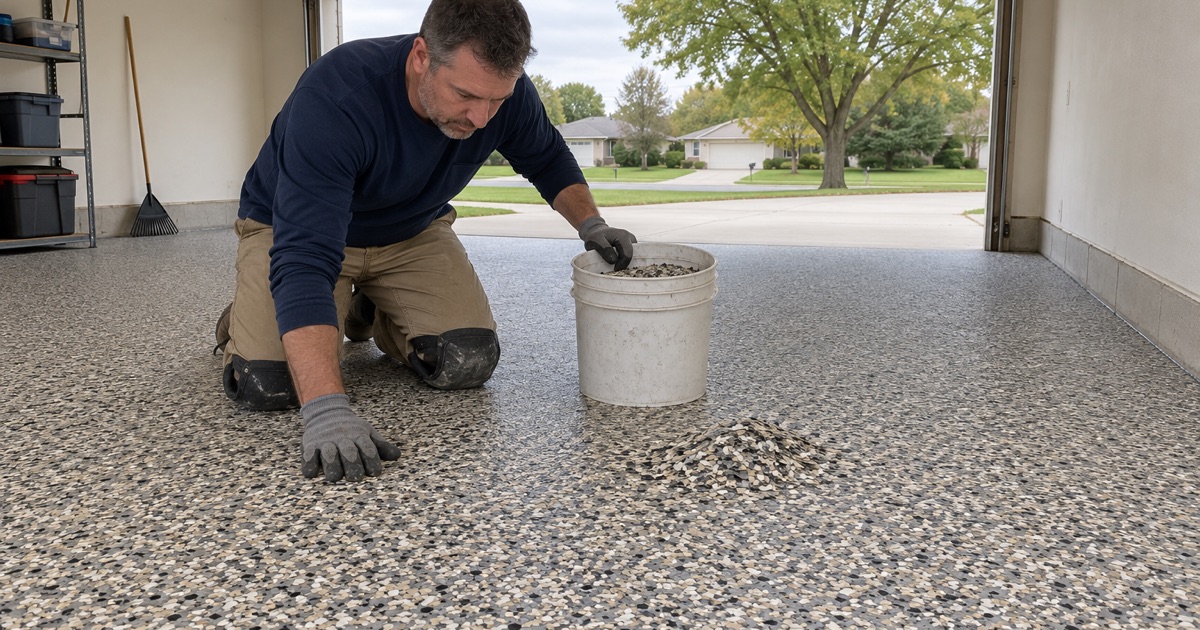
Flake comes in dozens of standard blends, from neutral grays and tans to bold mixes with reds and blues. Most blends combine several colors so the floor reads as one tone from a distance and shows detail up close.
We bring physical sample boards rather than relying on screen photos, because chip colors shift under garage lighting and daylight. Seeing a board on your own slab is the best way to choose.
Chip Size and Pattern
Chip size changes the look as much as color does. Smaller chips create a tight, speckled, granite-like finish, while larger chips create a bolder, more open pattern.
Smaller chips also tend to give a smoother finished surface, and larger chips leave more texture. We help you choose based on both the look you want and how the floor will be used.
Colors That Hide Salt and Dirt
In a Cedar Valley garage the floor takes salt slush, sand and mud for months each year. Mid-tone blends with several colors hide that winter grime best, while very light blends show dirt and very dark ones show dried white salt.
In basements and mudrooms, the same logic applies to dust and footprints. We ask how the room is used before recommending a palette.
Full Broadcast Versus Partial Broadcast
Full Broadcast to Rejection
In a full broadcast, flake is thrown onto the wet base coat until it will not take any more, which is called broadcasting to rejection. After cure, the loose chips are scraped and vacuumed off, leaving a dense layer of flake locked into the base.
This builds thickness and texture, hides imperfections and gives the topcoat an even surface to bond to. It is the system we recommend for garages and heavy-use floors.
Partial Broadcast Over a Color Base
A partial broadcast scatters a lighter amount of flake over a pigmented base coat, so the base color shows between the chips. It is a lighter, more decorative look and uses less material.
Partial broadcast works well in basements, offices and light-duty rooms. It hides less and builds less thickness, so it is not our first choice for a garage that sees winter driving.
The Layers Under and Over the Flake
Ground Slab and Base Coat
Flake does not fix a poorly prepared slab. We diamond grind to a named surface profile, fill cracks and spalls, and run a moisture test before applying a 100 percent solids epoxy or polyurea base coat.
The base coat holds the flake and bonds to the concrete, so its thickness is written into the quote. A slab with high moisture readings gets a moisture-mitigation primer first.
Clear Topcoat and Texture
After the flake is scraped and vacuumed, a clear topcoat seals it in. We use an aliphatic polyaspartic topcoat that resists ultraviolet light, road chemicals and hot tires, so the floor holds its color and gloss.
The number of topcoats controls the final texture. One coat leaves a more textured, grippy finish, while two coats make a smoother floor that is easier to mop.
Where Flake Floors Work
Garages, Basements and Mudrooms
Flake is our most common choice for garages, laundry rooms, basement workshops and mudrooms. It handles foot traffic, tools, pets and spills and cleans easily with a squeegee and mop.
In basements, we read for past water and test moisture first, since a coating cannot stop seepage. We look at the sump pit, the floor drain and any white efflorescence on the slab, and if the readings are high we start with a moisture-mitigation primer or recommend waiting until the water source is fixed.
Commercial Restrooms and Break Rooms
Commercial restrooms, locker rooms, break rooms and back-of-house areas use flake for a durable, seamless surface. Coved bases can carry the system up the wall a few inches for easy mopping.
Where floors see heavy wet cleaning or carts, we may suggest quartz instead. Quartz aggregate is harder than vinyl chip and holds texture longer under wheels and scrubbers, so it suits a commissary or a busy janitor’s corridor better, while flake remains the friendlier, more decorative choice for a staff lounge or a restroom.
In occupied buildings we phase the work and schedule nights or weekends, and we provide the certificate of insurance a property manager or general contractor asks for before we start.
- 20+ Years of Floor Work
- Moisture Test in Every Scope
- Free Written Estimates