
Cedar Falls Epoxy Flooring has been installing specialty floors for more than 20 years, including ESD flooring in Cedar Falls, IA, serving surrounding cities including Waterloo, Evansdale, Waverly, Independence and Oelwein. An ESD floor is designed to carry static charge safely to ground, protecting sensitive electronic components, test equipment and data hardware from electrostatic discharge.
These floors look like other epoxy coatings, but they are built differently underneath. A conductive primer, grounding connections tied to the building ground, and a carbon-loaded or conductive-fiber topcoat all have to work together, and the finished floor has to measure inside a resistance range rather than just look good.
We install static-dissipative and conductive epoxy systems for electronics assembly, engineering labs, test cells, server rooms and repair benches. Every job starts with the same ground slab and moisture test as any other floor, and ends with resistance testing before we hand it off.
What ESD Flooring Does
Static-Dissipative and Conductive Ranges
ESD floors are grouped by how quickly they drain charge. Conductive floors have the lowest resistance and drain charge fastest, while static-dissipative floors drain it more slowly and in a more controlled way.
Which range you need depends on what you are protecting and the standard your program follows, often ANSI/ESD S20.20 for electronics work. We build the floor to the resistance range written in your specification rather than to a generic product label.
The Floor as Part of a System
An ESD floor only protects what is connected to it. People need ESD footwear or heel straps, carts and chairs need conductive casters or drag chains, and benches need their own grounding.
We coordinate with your ESD coordinator or quality team so the floor fits the rest of the program. A floor that tests perfectly will not help an operator in rubber-soled shoes.
Where ESD Floors Are Used
Typical spaces include electronics assembly and repair areas, engineering labs, test cells, data and server rooms, and any room where sensitive equipment is handled or stored. Some facilities use them in areas with flammable vapors or dust, where a static spark is a safety concern.
In Cedar Valley manufacturing and engineering buildings, these rooms are often small zones inside a larger plant floor. We can install ESD flooring in those zones while the rest of the building is coated with a standard system.
How an ESD Epoxy Floor Is Built
Ground Slab and Moisture Testing
Every ESD floor starts with a diamond-ground slab, prepared to a named surface profile, with cracks and spalls repaired and ground flush. Old coatings are removed so they cannot interrupt the grounding path or fail under the new system.
A moisture test is written into the scope before pricing. Vapor rising through the slab can cause blisters or bond failure, and on an ESD floor it can also change resistance readings.
Conductive Primer and Grounding Points
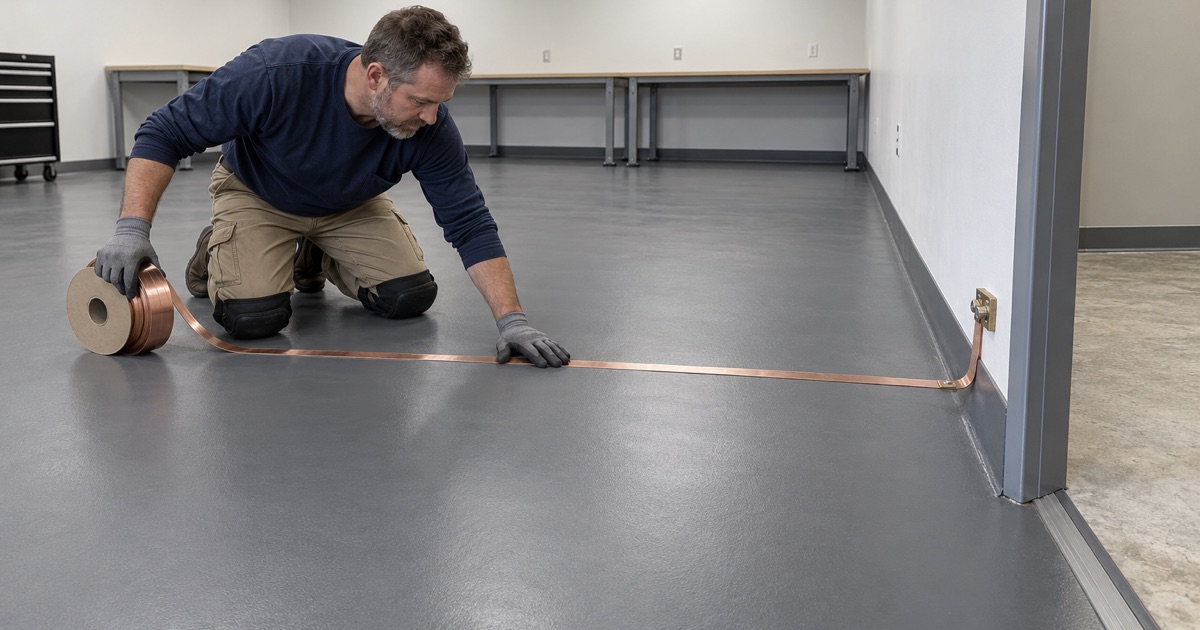
A conductive primer goes down first, and copper grounding strips are laid at planned intervals and tied to the building ground by an electrician or the facility’s own team. The primer spreads charge across the floor and carries it to those grounding points.
The layout of grounding points is planned before coating starts, based on the size and shape of the room. Getting this step right is what lets the topcoat do its job.
ESD Topcoat and Finish
The topcoat contains conductive fillers or fibers that carry charge from the surface down to the primer. It is applied at a controlled thickness, because too much material can raise resistance and push the floor out of range.
ESD topcoats come in a range of colors and can include a light texture for slip resistance. They are hard-wearing and chemical resistant like standard epoxy, and easy to clean with the right products.
Testing and Maintaining an ESD Floor
Resistance Testing After Cure
After the floor cures, we measure resistance to ground and point-to-point resistance across the room. The readings are recorded and compared with the range in your specification before the floor is handed over.
Any area that tests out of range is investigated and corrected before handoff, whether the cause is a thin spot, contamination or a grounding connection. You receive the readings for your ESD program records, along with a sketch of where the grounding points sit so future tests and repairs start from the same map.
Cleaning Without Insulating the Floor
Waxes, polishes and many floor finishes leave an insulating film that raises resistance and can push an ESD floor out of range. Use only cleaners the coating manufacturer approves, typically neutral cleaners with no residue.
We give your cleaning crew written instructions so a well-meaning floor finish does not undo the system. Contract janitorial staff change over time, so we suggest keeping those instructions posted in the room or with the cleaning supplies, where the next crew will actually see them.
Dry Iowa Winters and Static
Indoor air in Iowa gets very dry during the heating season, and dry air allows static charges to build more easily. That is often when ESD problems show up in facilities that were fine all summer.
Periodic retesting, especially in winter, confirms the floor is still performing. Combined with humidity control and footwear checks, it keeps the whole program working year-round.
- 20+ Years of Floor Work
- Moisture Test in Every Scope
- Free Written Estimates