
Cedar Falls Epoxy Flooring brings more than 20 years of floor coating experience to commercial kitchen flooring in Cedar Falls, IA, serving surrounding cities including Waterloo, Evansdale, Waverly, Independence and Oelwein. A kitchen floor works harder than almost any other floor in a building: it is mopped and hosed daily, splashed with hot water and grease, scraped by carts and racks, and inspected by the health department.
That is why we plan kitchen floors around the FDA Food Code as Iowa adopts it, with seamless surfaces, coved bases where the floor meets the wall, and a texture chosen for wet areas rather than for the showroom. The system is picked for what each zone of the kitchen actually sees, from the dish pit to dry storage. We work with restaurants, school and institutional kitchens, bakeries, breweries and food businesses, and we plan the work around service so the kitchen loses as few days as possible.
Floors That Pass a Health Inspection
The Food Code and Black Hawk County Inspections
Restaurant, grocery and school kitchens in Cedar Falls are inspected by the Black Hawk County Health Department, which handles food establishment inspections for Black Hawk and several neighboring counties under the FDA Food Code that Iowa has adopted. In food preparation and washing areas, floors are expected to be smooth, durable, easily cleanable and nonabsorbent.
A seamless resin floor meets that description far better than tile with failing grout, which traps food soil and water and is a frequent inspection note. We plan the system with those expectations in mind and can work from an inspector’s written comments if your kitchen has received one.
Coved Bases at the Wall
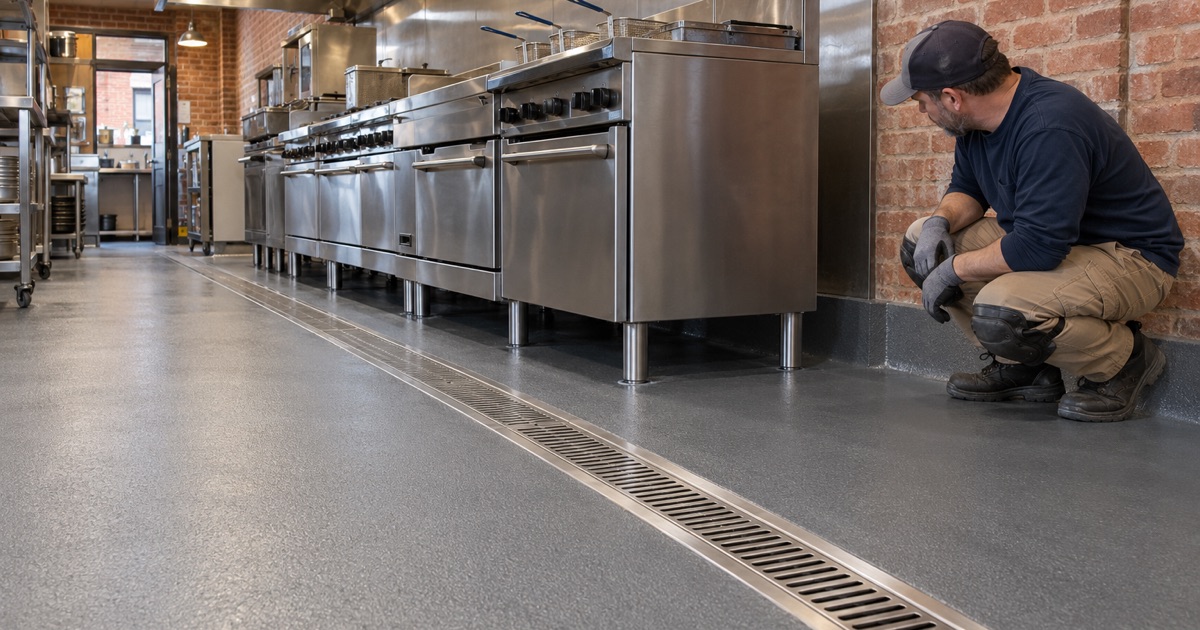
Where the floor meets the wall, a coved base carries the coating up the wall in a smooth curve a few inches high. It removes the hard corner where grease and dirt collect and lets the floor be mopped and squeegeed right to the wall.
Cove is built from the same resin system as the floor so it bonds and moves with it. We also detail around equipment legs, curbs and wall penetrations so there are no unsealed edges.
Texture for Wet and Greasy Areas
The Food Code allows antislip floor coverings in areas subject to moisture, and kitchen floors need grip where water and grease are constant. We broadcast quartz or other aggregate into the system and adjust the topcoat to control how much texture remains.
More texture gives more grip but takes more scrubbing to clean, so we zone it. The fryer line and dish area usually get the most grip, while dry storage and prep get a smoother finish.
Systems Built for Kitchens
Urethane Cement for Heat and Washdown
Urethane cement is our first choice for cook lines, dish rooms and washdown areas. It tolerates hot water, steam cleaning, thermal shock from spilled boiling liquids and many food acids and fats that would soften or discolor standard epoxy.
It is installed at a much greater thickness than a typical coating, often troweled or slurry-applied with aggregate, which also gives it strong impact resistance under carts and dropped pans.
Epoxy and Quartz Systems for Dry and Light-Duty Areas
In dry storage, the corridor outside the walk-in cooler, offices and light prep spaces, an epoxy or quartz broadcast system often provides a durable, easy-clean finish at a lower cost. These areas do not see the heat of the cook line. We make transitions between systems clean and flush so carts roll smoothly from zone to zone.
Drains, Slope and Grease
Floor Drains, Floor Sinks and Slope
Kitchen floors need to drain to floor drains and floor sinks rather than pond in low spots. We check existing slope, correct small low areas with mortar where possible, and seal the coating tightly to drain bodies so water does not get under the floor.
Where new drains or significant slope changes are needed, that is plumbing work. We coordinate with your plumber so the drains are set before the floor goes down.
Grease Interceptors and Grease on the Floor
Grease interceptors and their maintenance belong to your plumber and your local utility rules. We did not find a separate Cedar Falls grease ordinance like the one Waterloo enforces, so check current requirements with the city or your plumber.
On the floor itself, grease is the enemy of both slip resistance and bond. We degrease and grind old kitchen slabs thoroughly, because coating over grease-soaked concrete is one of the most common causes of kitchen floor failure.
Scheduling Around Service
Phasing, Nights and Closed Days
We plan kitchen projects around closed days, overnight windows and holiday breaks. Larger kitchens can be phased so part of the line keeps working while another section cures.
For school and institutional kitchens, summer and break windows are often the best time. Those projects are usually booked months ahead through a district or facilities office, so we confirm the cure schedule against the calendar early and leave room for the slab to be tested before the window opens.
Equipment, Odor and Return to Service
Equipment usually has to be moved, and we coordinate with your vendor or maintenance staff. We plan ventilation for coating odor and give a written return-to-service time so you can schedule deliveries and staff.
Before reopening, the floor should be cleaned with the products you will use day to day, so the crew learns how the new texture behaves under a mop and squeegee. We walk the kitchen with your manager, point out the coved corners and drain edges to keep clean, and leave written care instructions for the closing crew.
- 20+ Years of Floor Work
- Moisture Test in Every Scope
- Free Written Estimates