
Cedar Falls Epoxy Flooring has spent more than 20 years on concrete floor repair in Cedar Falls, IA, serving surrounding cities including Waterloo, Evansdale, Waverly, Independence and Oelwein. Most of that work happens ahead of a coating, because cracks, spalls and scaled patches have to be dealt with before a new floor can bond evenly, but we also repair bare slabs that just need to be safe and sound again.
Every repair job starts with a map. We walk the slab, mark each crack, joint, spall and scaled area, and decide what each one is telling us before we choose a material. A hairline shrinkage crack, a moving control joint and a crack from a settling slab look similar on the surface and need completely different answers.
We also say plainly when a slab needs more than a patch. If concrete is heaving, broken into plates or crumbling deep below the surface, repairing the top only buys time, and you should know that before spending money on it.
Cracks and Joints
Shrinkage and Hairline Cracks
Nearly every slab develops fine shrinkage cracks as it cures and ages. They are usually stable and cosmetic, and they are routed out or ground open, filled with a semi-rigid or rigid crack filler and ground flush with the surface.
Under a flake coating, a properly repaired shrinkage crack often disappears from view entirely. Under a solid color or metallic finish it may remain faintly visible as a thin line.
Control Joints and Moving Joints
Control joints are cut into slabs so the concrete cracks along a straight line rather than at random. Some joints stay still, while others open and close slightly with temperature and moisture.
We decide whether to fill a joint solid, fill it with a flexible joint sealant, or honor it through the coating so the movement has somewhere to go. Filling a working joint rigidly usually just moves the crack a few inches over.
Settlement and Structural Cracks
Wide cracks, cracks with one side higher than the other, and cracks that keep growing usually point to movement in the soil or base under the slab. Filling the surface does not stop that movement.
We point those cracks out and recommend getting the cause looked at before coating. In some cases the honest answer is slab replacement rather than repair.
Spalls, Pitting and Salt Scaling
Spalls at Doors and Joint Edges
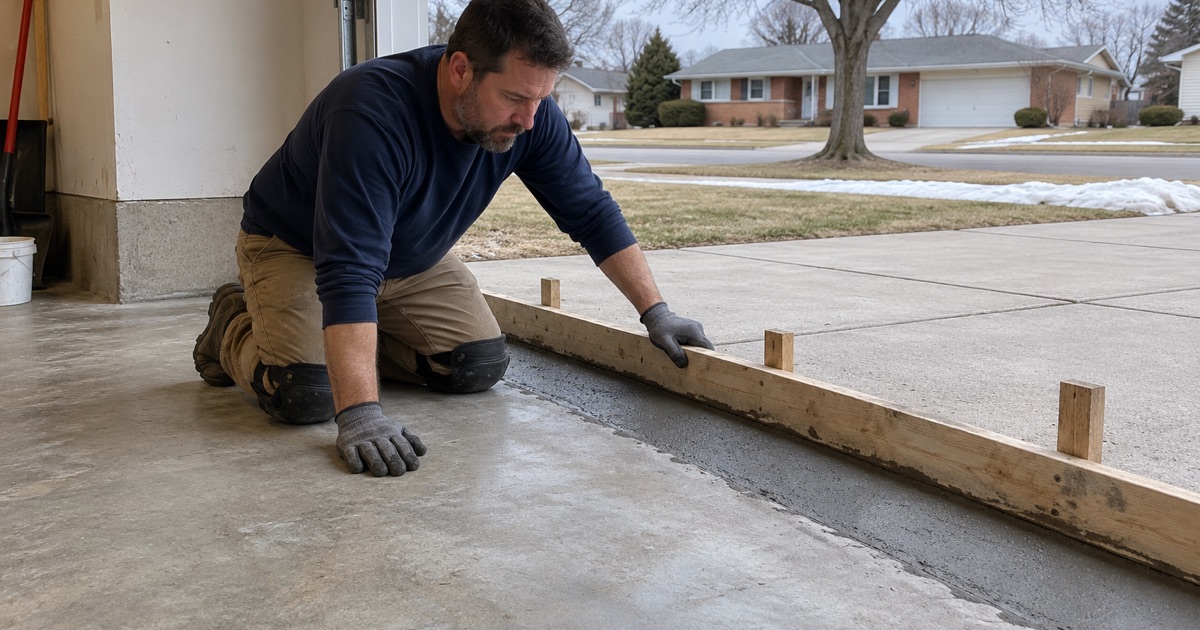
Spalls are chunks of concrete that break away, often at the garage door edge, along joints or where heavy loads have been dropped. Loose material is chipped or ground out to sound concrete, and the void is rebuilt with a repair mortar or epoxy mortar.
Once cured, the repair is ground level with the surrounding slab so the floor is flat and safe. A spall left open keeps breaking at its edges with every vehicle that rolls across it.
Freeze-Thaw and Salt Scaling
Cedar Falls is rated Severe for weathering in the city’s own code design criteria, and salty meltwater from Iowa roads soaks into garage slabs all winter. As it freezes and thaws, it pops the surface off in thin flakes, a defect called scaling.
We grind scaled areas back to sound concrete and resurface them with a repair mortar or a skim coat before coating. Sealing the slab afterward keeps salt water on top rather than letting it back into the concrete.
Pitting, Popouts and Rough Surfaces
Small pits and popouts happen when weak aggregate near the surface breaks free or when a poor finish wears away. They make a floor hard to clean and leave a coating with pinholes if they are not filled.
We fill pits with a fine repair compound or a tight scratch coat and grind the surface even. This step is often what separates a smooth, clean finish from a coating full of tiny holes.
Repair Materials We Use
Crack Fillers and Epoxy Mortars
We use fast-setting polyurea and epoxy crack fillers for most cracks, and epoxy mortar made from resin and graded sand for spalls and deeper voids. These bond strongly to ground concrete and are compatible with the coatings that go on top. The material is matched to the coating system and the movement expected, rather than using one filler for every defect.
Self-Leveling Overlays and Resurfacers
Where a slab is rough, worn or uneven across a large area, a self-leveling underlayment or resurfacer can restore a flat, sound surface. It is poured or troweled over the ground slab and bonds to it.
Overlays are useful before metallic and solid color coatings, which show unevenness more than flake. They do not fix a slab that is still moving or wet.
When Repair Is Not Enough
Heaved and Broken Slabs
Cedar Falls lists a 42-inch frost depth, and slabs that are not well drained beneath can heave as the ground freezes. A slab that has broken into separate pieces, tilted or lifted at its edges is often beyond surface repair.
We say so, even though replacement is not work we take on ourselves. A new coating over a heaving slab will crack along with it the next winter.
Water and Moisture Problems
Cracks that let in water, and slabs that stay damp, need the water source addressed first. We read the floor for past water and test moisture before repair, so a patch is not trapped over a wet slab. Once the water issue is solved, the repairs and coating can proceed on concrete that will hold them.
- 20+ Years of Floor Work
- Moisture Test in Every Scope
- Free Written Estimates