
Cedar Falls Epoxy Flooring has been installing epoxy garage floor systems for more than 20 years in Cedar Falls, IA, serving surrounding cities including Waterloo, Evansdale, Waverly, Independence and Oelwein. A garage floor here has to handle road salt, slush, warm tires, dropped tools and a long run of freezing nights, so we build it from a ground, tested slab up rather than rolling paint over bare concrete.
The work starts with what the slab can tell us. We map cracks, spalls and any old coating, run a moisture test that is written into the scope before we price, and tell you plainly if the concrete needs repair or replacement before it is worth coating. Only then do we write a quote naming the system, coat count and finished thickness.
Most of our garage floors are flake systems with a clear protective topcoat, but we also install solid color, quartz and metallic finishes. Whichever look you choose, the preparation, testing and cure schedule underneath it stay the same.
Reading the Garage Slab Before Any Coating
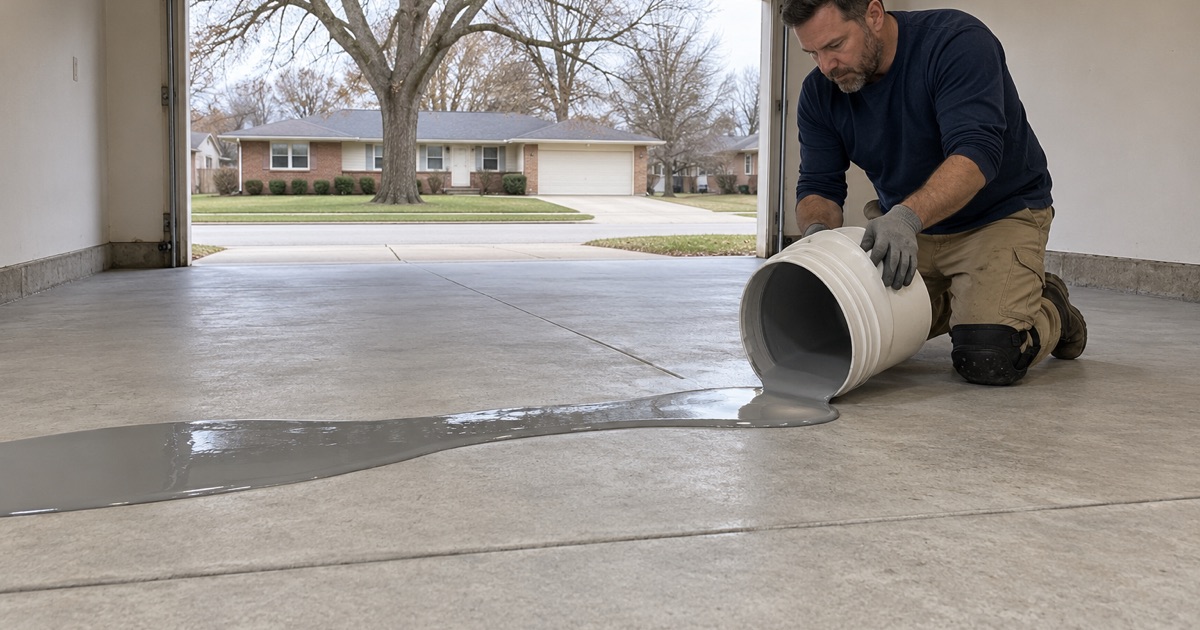
Moisture Testing Under a Garage Floor Coating
Garage slabs carry a quirk of the model residential code: the vapor retarder required under heated living space is not required under a garage. That means many garage slabs sit directly on the gravel base, and vapor moving up through them can push a coating off from underneath.
We start with a plastic sheet test under ASTM D4263 as a quick screen. Where the floor calls for numbers, we use calcium chloride testing under ASTM F1869 or in-situ relative humidity probes under ASTM F2170, and the reading decides the primer.
Crack, Spall and Pitting Map
We walk the slab and mark every crack, control joint, spall and pitted area before quoting. Shrinkage cracks and small spalls at the door edge are routine and get filled with a repair material matched to the coating.
When the slab has settled, heaved into plates or is scaling across large areas, we tell you so. Coating over concrete that is still moving hides the problem only until the next freeze-thaw season.
Old Paint, Sealers and Failed Coatings
Many garages already carry a coat of floor paint, a penetrating sealer or a store-bought kit that has started to peel. A new system bonded to that layer is only as strong as it is, so we grind it off and work down to sound concrete. It adds time, but it is the step that separates a floor that lasts many winters from one that lifts in patches along the tire paths.
Epoxy Garage Floor Systems We Install
Flake Broadcast Over a High-Solids Base
Our most requested garage system is a 100 percent solids epoxy or polyurea base coat with a full vinyl flake broadcast, scraped and sealed under a clear topcoat. The flake hides small slab imperfections, adds texture and comes in blends from tight granite looks to bold open patterns. Full broadcast means the base is covered to rejection, which builds thickness and gives the topcoat a uniform surface to lock into.
Polyaspartic Topcoats for Sun and Salt
Standard epoxy can amber when sunlight comes through an open garage door, so we seal flake floors with an aliphatic polyaspartic topcoat. It holds its color, resists road chemicals and cures faster than an epoxy clear coat. We set topcoat thickness in the quote, because it is the layer that takes the wear from tires, salt and dragged equipment.
Solid Color, Quartz and Metallic Options
A solid color coating suits a working shop where the floor needs to be bright and easy to mark. Quartz broadcast adds hardness and grip for a heavy-use garage, and metallic epoxy gives a showpiece garage a marbled finish. Each option sits on the same ground slab and the same moisture plan, and only the finish layers change, so the choice between them is about looks, grip and how hard the garage is worked rather than about how long the floor will stay bonded.
Our Step-by-Step Epoxy Garage Floor Process
Step 1: Diamond Grinding to a Named Profile
We grind the garage with diamond tooling, or shot blast larger slabs, to the ICRI concrete surface profile named in the proposal. Grinding removes the weak top layer, curing compounds and contamination that acid etching leaves behind. Dust is captured at the grinder with a vacuum rather than washed toward the floor drain or out to the street.
Step 2: Repairs, Joints and Primer
Cracks and spalls are filled and ground flush, and joints are treated according to whether they need to keep moving. A slab that tested damp gets a moisture-mitigation primer instead of a standard one.
The primer is worked into the open pores of the ground concrete so the base coat has something to grip. On older garages with a patched apron or a cracked strip by the door, this is also where we rebuild edges, so the finished floor reads as one surface instead of a coating stretched over old repairs.
Step 3: Base Coat and Broadcast
The base coat goes down at the thickness written in the quote, and flake or quartz is broadcast into it while it is wet. Once it cures, we scrape and vacuum off loose material so the topcoat lands on a clean, even surface.
The broadcast is where most of the floor’s thickness and texture come from, so we do not thin it out to save material. A partial broadcast can look fine on day one, but it leaves more exposed base for tires and salt to work on, and the floor wears unevenly along the parking lanes.
Step 4: Topcoat, Texture and Cure
The clear topcoat is rolled on with any anti-slip additive mixed in. We then give you the foot-traffic date and the vehicle date, set by the product and the slab temperature rather than a fixed number of days.
Before we leave, we walk the floor with you against the quote: the profile, the coat count, the broadcast and the finished thickness. You get care instructions for the first weeks, including how long to keep heavy items, jack stands and lawn equipment off the new surface while it reaches full hardness.
Garage Floors Through an Iowa Winter
Salt, Brine and Freeze-Thaw Scaling
Cedar Falls lists its weathering exposure as Severe, and from late fall to early spring the brine and rock salt on local roads come home on every tire. On bare concrete that salty meltwater soaks in, freezes and slowly flakes the surface away.
A sealed garage floor keeps the slush on top where it can be pushed out the door. We size the topcoat and texture for that winter routine, not for a showroom that never sees a car.
Cold Slabs, Dew Point and Amine Blush
The 1991-2020 normals for the Waterloo airport record about 150 nights a year at or below freezing. An unheated garage slab can stay too cold, or too close to the dew point, for a coating to cure properly long after the air warms up.
We measure slab temperature and the dew point spread on the day. If the numbers say wait, we reschedule rather than risk a soft cure or a greasy amine blush between coats.
Attached Garages, Odor and Re-Entry
In an attached garage the house door, a shared wall and sometimes the furnace sit right next to the work. We seal the door, capture grinding dust at the machine and plan around air returns.
Low-odor products are available for families who want an easier re-entry. They are a comfort choice, not an Iowa requirement, and we price them that way.
- 20+ Years of Floor Work
- Moisture Test in Every Scope
- Free Written Estimates